Monday, October 25, 2010

Studying fashion has made me feel good about my body

A few days ago while I was getting dressed I looked down and saw that I had a little bit of a belly. I patted it, hoping it was an optical illusion, and sighed for a moment feeling sorry for myself that I don’t have a flat stomach like I should. But then I came to my senses and remembered the lessons I've learned from fashion history.


I’m not about the make the argument that fashion celebrates women of all body types. In fact, in every era, fashion has promoted a certain type as ideal. During my first semester at FIT I learned that the fashionable body is, and always has been, a distorted one. Limbs are elongated in paintings, waists are made wasp thin in fashion plates, and photographers use angles and lighting to play tricks. Today, of course, we have photoshop.


The real problem is that in every era we assume that this year’s standard of beauty is universal. Today we believe that that big boobs, flat stomachs, small waists, and a toned physique make up the absolute, universal standard of female beauty. But frankly that isn’t true. In the 1920s the ideal body was flat and without curves. In the Renaissance it was fashionable to have a bit of a belly, and women would dress with extra fabric in the front of their gowns to enhance the effect. Later Renaissance nudes usually show the torso as barrel shaped (much like the effect of the corset at the time) making the breasts small and the chest/waist/stomach all roughly the same size around. Today we have this idea that bodies should be toned and skin look like it is smooth and tight. But a 17th century woman would have hated looking that way. During the time of Rubens, women were supposed to be soft and “fleshy.” Nothing was more alluring that dimpled, rippling, squishy skin.


When you look at the history of fashion ideals you realize something: women have always had women’s bodies. We all have different attributes and sometimes some of us are lucky enough to be alive when one of our things is “in.” A girl with the ideal look of the 1920s would have hated her body in 1900, and would probably have spent extra money on “bust enhancers” and hip padding. Conversely, someone with the perfect “Gibson Girl” form from 1900 would be unhappily trying to flatten and minimize her curves in 1925. In one era fashion told these ladies that they were beautiful, and in another that they were shamefully incorrect. But in the end, they were both just two kinds of natural body types.


As with the study of any historical subject, learning the history of fashion helps you step out of your own time and see the bigger picture. And let me tell you, the bigger picture has lots of sexy belly fat.


Sunday, October 17, 2010

Not in the Spirit of Community Living

I love Menno House, but it is becoming clear that I have some sort of complex about it. I think it boils down to this: When I applied to the house I was a poor student watching my savings shrink as I paid a hefty rent and labored at a 10 hour a week job paying $7.35 /hr. But when I moved in to Menno House I had a good job and a tuition exemption. I feel like I tricked the system a little. Of course, when I express this feeling to my housemates they give me a funny look and assure me it doesn't matter. But I'm a champion worrier, so I've got it into my head that I will be found out and evicted. I've already had two anxiety dreams to that effect.


Most of my housemates are working at low paying jobs or are part of Mennonite Voluntary Service, which is sort of like Americorps. The MVS people have a food stipend and then $50 a month of discretionary spending. That is barely anything, especially in this city. When I moved in, one of the outgoing residents told me that moving my stuff up all those stairs would be a bigger headache than I expected. "But," he told me, "The MVSers will do anything for $10. Get them carry it."


Ever since he said that I've been tempted to pay my housemates to do things for me. I make money, they need money. Who doesn't want an underpaid servant ready to do your bidding? The main thing stopping me is the worry that it would be against the community spirit of the house. We all have to do our part with chores and cooking the weekly house meal. The last thing I want is to be seen as a bad apple and get kicked out of the house for not being "community oriented" enough.


This Saturday was house cleaning day. From 10am to 6pm, everyone had to clean and complete needed maintenance projects on the house. If you couldn't be there, you had to make up those hours later. Well, I work on Saturdays, so I put in as many hours as I could but still had time to make up. Last night I put in some time waxing the kitchen floors and stamping "Return to Sender" on a giant pile of mail that had come for former residents. But when that was all over I still had about 2 hours to go. The house manager asked that I put down two more layers of wax on the floor this evening. I really wanted to get some homework done, so I asked her if it would be bad form for me to pay someone to do it. I think in real life she just shrugged, but in my head she gave me a disapproving look and said "That is between you and God."


Well, dear readers, I did it. I knocked on the door of one of the MVSers and offered her $20 to do my work. I'm feeling half guilty, and half ready to burst into an evil laugh. I ended up getting a lot of homework done, but I also started to notice that my shelves could use a good cleaning. A good cleaning that I certainly don't have time for...

Saturday, October 9, 2010

Fashion & Controversy

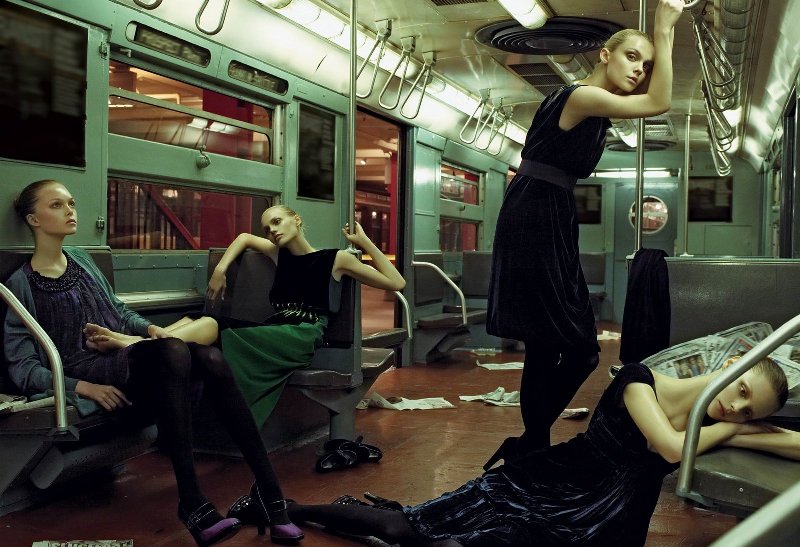
I LOVE my special topics (a.k.a. DDR) class. We read philosophy, look at fashion magazines, and have discussions about what it all means. Most of the time we are pretty hard on the editorials or ads we look at. We’ve discovered that every Alberta Ferretti campaign seems to involve four emaciated women (we’ve decided they are sisters) who are too weak to stand and seem to be in some unsafe location. Their favorite hangouts include a windy manor house, various subway cars, and a mysterious institution with lots of black drapery. What is the message of these ads? Should we be worried about these women? Why is it that somewhat unsettling images seem to sell clothes?


This week however, we spoke favorably about an editorial that elsewhere had caused outrage. I’m talking, of course, about Vogue Italia’s “Water & Oil” spread in which the tragedy of the gulf oil spill was retold with a model and several thousand dollars worth of designer clothes (go here to see the pictures). The many angry responses to this shoot boiled down to three main points:


-It is disgusting to glamorize an ecological disaster

-It is appalling that they are using the oil spill to sell clothing and make money for the magazine

-How dare fashion get above itself and attempt to tackle a real world issue


Here is what we discussed:


Point one: It is disgusting to glamorize an ecological disaster

Okay, take a close look at the images from the shoot. Forget for a moment that you are looking at a fashion editorial and just think about what kinds of thoughts and feelings the photos convey. Do you think it is glamorous? Does the model look chic and fab? Do you imagine someone looking at that haunting shot of her face covered in oil and saying, “ooh! Where can I get that look?” No. The images are dark and disturbing. Fashion photography does not always equal glamour.


Point two: It is appalling that they are using the oil spill to sell clothing and make money for the magazine

Again, this photo shoot really isn’t about making readers covet the model’s look. The clothes look dirty, torn, and grey—unlike the Alberta Ferretti ads in which the women may be ill but the clothes still look expensive and alluring. So if it isn’t to sell clothes, what is the point? If this is “art” then why use designer clothes at all?


That was my question, but as my professor pointed out, the clothes help tell the story. The model is made to look birdlike by wearing feathers, or seal and fish-like by wearing shiny fabric that looks wet. Other pieces echo the natural forms of the rocks or the seaweed. Some of it simply looks frail and torn. “Fashion is the perfect metaphor for death,” my prof explained. “It is ephemeral and replaceable, with new trends burying the old. Fabric, like the body, is fragile and easily broken.”


People make money off of tragedy all the time, but in those other contexts we assume that the intent is honorable. For example, someone in Hollywood makes a movie about the holocaust just about every year. Have you ever heard people rail against how disgusting it is that someone is profiting from murder of six million people? No, because we believe that the movies have something to teach and that the profit made by the studios is just part of how the system works. Which brings me to the next point…


Point 3: How dare fashion get above itself and attempt to tackle a real world issue

As you can imagine, we get very defensive about this. There is a widespread perception that fashion is completely frivolous, has no meaning, and isn’t something that anyone should actually consider important. It never has anything to say about politics, economics, or society and it shouldn’t try. People have worn things to cover their bodies since the beginning of time, yet everyone sure that there is no connection between clothing and the human experience. How dare it get mixed up in the “real” world.


Yes, fashion is part of a capitalist system—but as my prof put it, fashion is “sort of like the angsty step-daughter who is happy to bite the hand that feeds her.” Where did these high-end clothes come from? What sort of energy went in to making them? What sort of energy went into making the clothes that you are wearing? BP may deserve the bulk of the blame for the spill, but aren’t we all part of a system that created the need for an oil industry?

Saturday, October 2, 2010

Be Careful What You Wish For

This has been a terrible week for homework. A total disaster as far as getting work done and working ahead on upcoming projects. My fears about Menno House have come true: I’m having too much fun with my housemates. Here is how it played out:


Monday: I discover that several of my housemates have not seen my favorite movie Strictly Ballroom. Watching commences immediately.


Tuesday: “What? You haven’t seen Romy and Michele’s High School Reunion either? Sit down.”


Wednesday: “Hey Clara, you went to college in the Midwest. Do you know how to play Euchre?”

“I love Euchre! Deal me in!”

“By the way, what are you doing Thursday night?”

“Menswear class.”

“Oh, because I was going to stand in line for rush tickets to the Opera. I’ll get two tickets and it is the Met’s new production of Rheingold.”

[Jaw drops]


Thursday: Dear menswear professor, I will not be able to attend class this evening due to an unexpected conflict…


Yeah, so the trade off for not getting any work done was the AWESOME experience of paying $20 to see Met’s new production of Rheingold—featuring the much-hyped set by Robert Lepage. Last year I was offered a free ticket to Siegfried but I had to give up another event in order to go. Choosing the opera ended up being 100% the right decision, so I now understand that when life offers you Wagner, you drop everything and go. We had great seats and the music was fantastic. Truth be told, I was a bit underwhelmed by the set and the staging (Of course Seattle's production is better), but I got to be a real New Yorker and snobbishly discuss the pros and cons of the performance on the subway ride home.


All in all, this has been a great week. I feel like I'm enjoying life here and taking advantage of what the city has to offer.


Oh wait. Aren’t I in grad school or something?


Saturday, September 25, 2010

Drinking on a Budget

Blurg. Except for the crunch around finals, I try to post something every week. But here it is, a full fortnight since my last post. Last weekend my parents were here, so I guess my official excuse was that I was running around with them. It was a good weekend. We went to two Broadway shows: La Cage Aux Folles and Wicked which were both delightful (Kelsey Grammar can't sing btw). Of course there were also the requisite museum visits and nice meals at restaurants. It was quite lovely.


Anyway, I can’t think of some kind of theme for this week, so I’m just going to tell you a story.


About two weeks ago I went out with two of my housemates to a bar. I was loving it because we had walked there, and walking with friends to a neighborhood bar was one of the things I missed when living in Park Slope. The place was crowded and noisy. At one point the lights turned off for a minute but then came back on. Then they went off again. Then we heard someone saying “Everybody OUT.” The way they said it, it registered more as angry “Party is over, guys” shouts than anything being wrong. We shuffled toward the door, moving slowly because there were so many people in front of us. Behind us was a woman screaming “GET OUT! WHAT IS WRONG WITH YOU PEOPLE!” She kept screaming and pushing, which was obnoxious because we couldn’t go any faster than the person in front of us. She seemed like the pedestrian version of a driver than leans on his horn in gridlock traffic.


When we finally got out we heard someone say something about a fire. Then a fire truck pulled up. Then another. Then another. Eventually there were five. A few guys suited up and went in to the bar, but there didn’t seem to be much urgency. We saw no flames or smoke. Just for kicks, one fireman opened up the hydrant and let it run into the street for a while. We stuck around because one of my friends had left her sweater and the other had opened a bar tab. Eventually the one with the lost sweater was able to talk the bouncer into retrieving it (confirming the fact that the bar was not consumed with fire) but he refused to return any credit cards. Eventually they told us that the bar would be closed for the rest of the night so we went home.


It was all very strange. While I don’t think that I was ever in any real danger, it was weird that there had been some sort of legitimate fire in the bar and that we weren’t told until we had exited. Of course yelling “fire” in a crowded space could cause panic, but since we didn’t know what was going on, everyone just ambled toward the door. Is there a medium between panic and annoyed indifference?


Anyway, the friend with the open bar tab went back the next day (at the time they had told her to return) and found the place still closed. She cancelled the card and so all our drinks that night ended up being free.

The end.

Saturday, September 11, 2010

Mannequins and DDR

Amid the hubbub of moving I started all my classes for fall. Here is what my semester looks like:


Exhibit: Plan & Interpretation—This is a big one. Every spring the second year students in my program put on an exhibition at the Museum at FIT. We’ve all been looking forward to it with a mix of excitement and fear. As rewarding and valuable as it is to create a real museum exhibit, the project also has a history of creating exhaustion, frustration, and bitterness. One of the points of tension is the assignment of jobs. A few positions (the curators mainly) do the majority of the work. They learn the most and get the most credit, but the commitment of time and effort is brutal. Those with smaller jobs are less stressed out, but resent how little they are getting out of the experience.


I put my name in for curator, and part of me really wanted it. It is a huge honor, and it must feel great at the end to look at the exhibit and say, “I did this.” However with my 21 hour per week job I was worried about the time commitment. My nervousness only increased when we met for the first day of class. Something about the way the project was presented filled me with nervousness and dread (I can’t go into much detail, but the term “dictator” was used in positive context). That Friday we each got phone calls announcing our positions. At first I was disappointed to get a small job, but the more I think about it the more I realize it is the best thing that could have happened. If I were curator I'd be looking forward to six months of unparalleled stress and pressure. I'll still be busy with school, but I'll have breathing room to pay attention to my other classes, hang out with my housemates, and sleep regularly. I’m in charge of PR. So far I’ve read examples of press releases and picked out a dress to wear for the media preview in March.


History of American Men’s Wear—Pretty much what it says on the tin.


Costume & Textile Mounting Skills—This is, in essence, mannequin dressing. Sound easy and lame? It is actually one of the best and most valuable courses offered in the program.


The class is taught by a woman who worked for years at the Met and is something of a legend in the field. Her approach requires that we read books on anatomy in order to understand the human body and how it is modified by clothes in various periods. Over the course of the semester we have to diagram 10 period garments (from a study collection) and show exactly how they are proportioned and how they are put together. How are the seams finished? How are the shoulders cut? How is the skirt pleated? This is our chance to really get into the details of clothing. With an understanding of construction and anatomy, we can start to understand how people stood and held their bodies in various periods. Each garment expects a certain structure underneath. You just need to know how to create the right one.


Special Topics—also known as “DDR.” Last semester we got to vote on the topic for this seminar. We settled on an awesome one: Deconstruction, Destruction, and Reconstruction. We are exploring the recent tendency in fashion to have clothes that look like they are missing pieces, falling apart, or crudely put together. The most familiar examples are jeans that come pre-torn or shirts that are made to look like they are inside-out. This is heavy fashion theory. On our first day our professor explained that this phenomenon first appeared right before the fall of the Berlin Wall and then gained strength again in the wake of September 11. What does it say about our society that we seem drawn to dressing like we’ve been through some violent or earth-shattering event? Last week we read a book called Structuralism and Post-Structuralism for Beginners. It was awesome. I love it when my supposedly vapid and superficial field becomes mind-bendingly thought provoking.


Friday, September 3, 2010

I Moved!

I did it! I successfully moved from Brooklyn to Manhattan! Once my room looks less like I dumped the contents of my suitcases on the floor (which I miiiiight have done) I will post pictures. In the meantime, I’ll share some tidbits from the move.


In terms of doing the actual move, I was sort of lost. I had just enough stuff to make it hard to do on my own (on the subway or with taxis), but not enough to make it worthwhile to hire movers. Someone suggested renting a U-haul, but driving a giant van in New York sounded worse that taking 50 trips on the subway. So for a while I was planning to go with the subway method. But then I had a lucky break--someone moving out of Menno House was renting a U-haul and wanted to share. When she explained that she had to drive it the whole time for insurance purposes, I became very enthusiastic. So on Monday I put on my running clothes and spent a hot, sweaty day moving.


Once I had the U-haul planned, I realized I didn’t have enough boxes. I mentioned this to one of my coworkers, and she had a quick answer. “Just go to the liquor store,” she said, “They always have boxes.” Hmm. Interesting. So I approached my local store, and said, “This might be an odd request, but I am moving soon and…” “Yeah, sure, boxes.” The guy said. He called over another employee and they brought me what they had. Amazing! So I moved into Menno House with my stuff packed in containers for rum and Jack Daniels.


The U-haul day was Monday, but I didn’t officially start living at Menno House until Wednesday (the bulk of my stuff hung out in the MH basement in the meantime). On Wednesday it was sort of sad to say goodbye to John. We had a good rapport, and I think he was sorry to see me go. His new roommate seems cool, but he is bringing another older cat into the apartment. That means that there will be two 16 year old cats and one 10 year old without teeth. I can’t help but think that I got out just before the apartment became a geriatric kitty ward. (Just before I left, John had to ban one of the cats from his bed because she was getting into the habit of pooping there instead of going all the way to the litter box.)


I had one class on Wednesday, and through most of it I kept thinking about how exciting it would be to walk home when class was over. If my first night is anything to go by, I think my time at Menno House will be pretty great. We shared a delicious house dinner and then had a Beyoncé dance party while cleaning the kitchen. Then, when I mentioned that I owned seasons 1-5 of Project Runway on DVD, half the house got super excited and wanted to get started on season 1 right away.


By the way, to give you an update from my last post, Thailand apparently won the costume contest.