No, not THAT kind of "men's magazine." This kind:

My research into the world of patterned men's pants is in full swing. Which means that I've been spending quality time with old issues of GQ. Let's see what we've found...


A few days ago while I was getting dressed I looked down and saw that I had a little bit of a belly. I patted it, hoping it was an optical illusion, and sighed for a moment feeling sorry for myself that I don’t have a flat stomach like I should. But then I came to my senses and remembered the lessons I've learned from fashion history.
I’m not about the make the argument that fashion celebrates women of all body types. In fact, in every era, fashion has promoted a certain type as ideal. During my first semester at FIT I learned that the fashionable body is, and always has been, a distorted one. Limbs are elongated in paintings, waists are made wasp thin in fashion plates, and photographers use angles and lighting to play tricks. Today, of course, we have photoshop.
The real problem is that in every era we assume that this year’s standard of beauty is universal. Today we believe that that big boobs, flat stomachs, small waists, and a toned physique make up the absolute, universal standard of female beauty. But frankly that isn’t true. In the 1920s the ideal body was flat and without curves. In the Renaissance it was fashionable to have a bit of a belly, and women would dress with extra fabric in the front of their gowns to enhance the effect. Later Renaissance nudes usually show the torso as barrel shaped (much like the effect of the corset at the time) making the breasts small and the chest/waist/stomach all roughly the same size around. Today we have this idea that bodies should be toned and skin look like it is smooth and tight. But a 17th century woman would have hated looking that way. During the time of Rubens, women were supposed to be soft and “fleshy.” Nothing was more alluring that dimpled, rippling, squishy skin.


When you look at the history of fashion ideals you realize something: women have always had women’s bodies. We all have different attributes and sometimes some of us are lucky enough to be alive when one of our things is “in.” A girl with the ideal look of the 1920s would have hated her body in 1900, and would probably have spent extra money on “bust enhancers” and hip padding. Conversely, someone with the perfect “Gibson Girl” form from 1900 would be unhappily trying to flatten and minimize her curves in 1925. In one era fashion told these ladies that they were beautiful, and in another that they were shamefully incorrect. But in the end, they were both just two kinds of natural body types.
As with the study of any historical subject, learning the history of fashion helps you step out of your own time and see the bigger picture. And let me tell you, the bigger picture has lots of sexy belly fat.


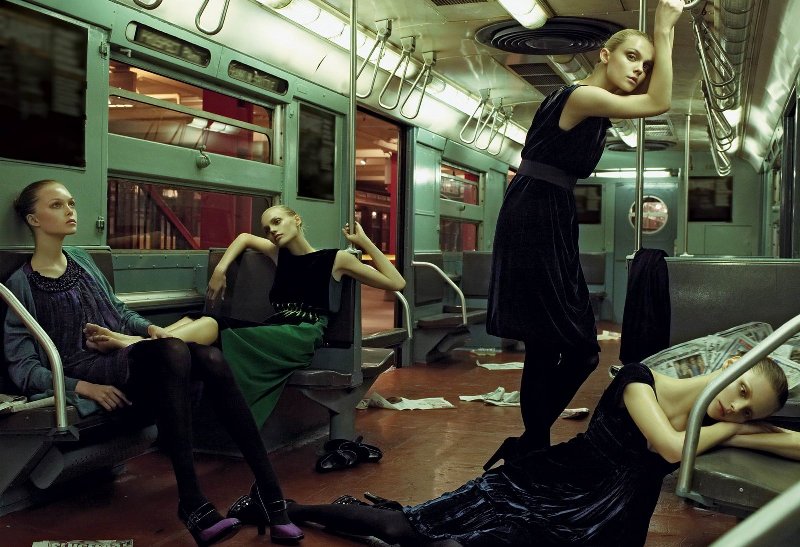
I LOVE my special topics (a.k.a. DDR) class. We read philosophy, look at fashion magazines, and have discussions about what it all means. Most of the time we are pretty hard on the editorials or ads we look at. We’ve discovered that every Alberta Ferretti campaign seems to involve four emaciated women (we’ve decided they are sisters) who are too weak to stand and seem to be in some unsafe location. Their favorite hangouts include a windy manor house, various subway cars, and a mysterious institution with lots of black drapery. What is the message of these ads? Should we be worried about these women? Why is it that somewhat unsettling images seem to sell clothes?
This week however, we spoke favorably about an editorial that elsewhere had caused outrage. I’m talking, of course, about Vogue Italia’s “Water & Oil” spread in which the tragedy of the gulf oil spill was retold with a model and several thousand dollars worth of designer clothes (go here to see the pictures). The many angry responses to this shoot boiled down to three main points:
-It is disgusting to glamorize an ecological disaster
-It is appalling that they are using the oil spill to sell clothing and make money for the magazine
-How dare fashion get above itself and attempt to tackle a real world issue
Here is what we discussed:
Point one: It is disgusting to glamorize an ecological disaster
Okay, take a close look at the images from the shoot. Forget for a moment that you are looking at a fashion editorial and just think about what kinds of thoughts and feelings the photos convey. Do you think it is glamorous? Does the model look chic and fab? Do you imagine someone looking at that haunting shot of her face covered in oil and saying, “ooh! Where can I get that look?” No. The images are dark and disturbing. Fashion photography does not always equal glamour.
Point two: It is appalling that they are using the oil spill to sell clothing and make money for the magazine
Again, this photo shoot really isn’t about making readers covet the model’s look. The clothes look dirty, torn, and grey—unlike the Alberta Ferretti ads in which the women may be ill but the clothes still look expensive and alluring. So if it isn’t to sell clothes, what is the point? If this is “art” then why use designer clothes at all?
That was my question, but as my professor pointed out, the clothes help tell the story. The model is made to look birdlike by wearing feathers, or seal and fish-like by wearing shiny fabric that looks wet. Other pieces echo the natural forms of the rocks or the seaweed. Some of it simply looks frail and torn. “Fashion is the perfect metaphor for death,” my prof explained. “It is ephemeral and replaceable, with new trends burying the old. Fabric, like the body, is fragile and easily broken.”
People make money off of tragedy all the time, but in those other contexts we assume that the intent is honorable. For example, someone in Hollywood makes a movie about the holocaust just about every year. Have you ever heard people rail against how disgusting it is that someone is profiting from murder of six million people? No, because we believe that the movies have something to teach and that the profit made by the studios is just part of how the system works. Which brings me to the next point…
Point 3: How dare fashion get above itself and attempt to tackle a real world issue
As you can imagine, we get very defensive about this. There is a widespread perception that fashion is completely frivolous, has no meaning, and isn’t something that anyone should actually consider important. It never has anything to say about politics, economics, or society and it shouldn’t try. People have worn things to cover their bodies since the beginning of time, yet everyone sure that there is no connection between clothing and the human experience. How dare it get mixed up in the “real” world.
Yes, fashion is part of a capitalist system—but as my prof put it, fashion is “sort of like the angsty step-daughter who is happy to bite the hand that feeds her.” Where did these high-end clothes come from? What sort of energy went in to making them? What sort of energy went into making the clothes that you are wearing? BP may deserve the bulk of the blame for the spill, but aren’t we all part of a system that created the need for an oil industry?